
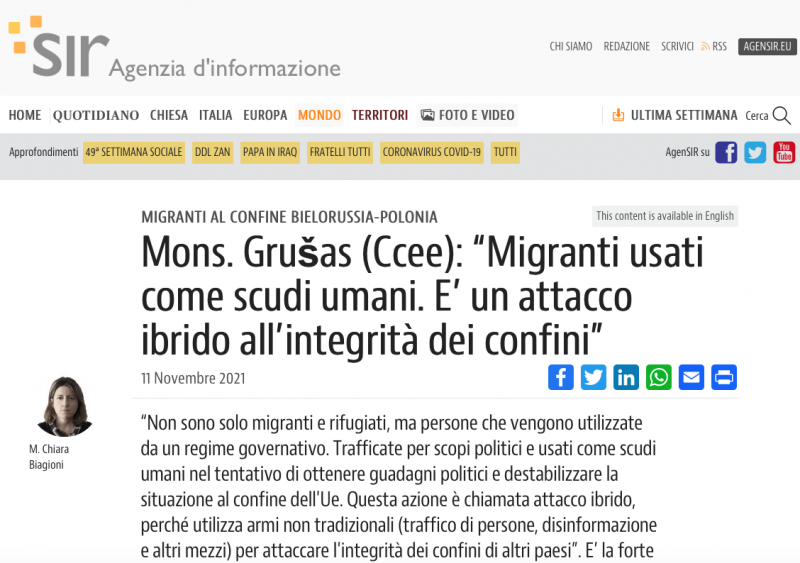
In the interview given to the SIR agency (Religious Information Service) H.E. Msgr Gintaras Grušas, Archbishop of Vilnius and CCEE President, appeals to the international political community: “act to help end this unconventional military action and work towards ending this form of illegal human trafficking for political gain. The time for mercy is now”.
The full text of the interview.
“It is with great sadness that we see these images and the suffering that people are enduring. Families with children that are trapped at the border. But it is very important to understand also what is behind the images that we see. These people are not only migrants and refugees, but they are people who are being used by a government regime”. Monsignor Gintaras Grušas, Archbishop of Vilnius and new President of the Council of European Bishops’ Conferences, used clear and direct words to describe and denounce what is really happening on the border between Belarus and Poland, where about 4,000 migrants, mostly fleeing Syria and Iraq, have gathered in camps near Kuznica. He added: “They are being trafficked for political purposes and used as human shields in an attempt to make political gains and to destabilise the situation at the EU border. This action is called a hybrid attack, because it uses non-traditional weapons (trafficking of people, misinformation and other means) to attack the integrity of other countries borders.
Who are the people crossing this route to Europe?
I was able to talk with some of the refugees. Many are trying to escape from the horrible situations in their home countries. Several had seen the horrors of war, even their family members killed before their eyes. Some are fleeing persecution on religious grounds as well. Some are looking for a better life. Others were students from various African nations who were given the opportunity to study in Belarus. When the Lukashenko regime decided to begin this action to create a border crisis with the European Union, they raised the rent for dormitories for these foreign students to a level they could not afford to pay. At that point, they were given the choice of returning to their own country or “going to the EU”.
Then what happens?
Faced with that choice, they chose to go to the EU, not fully understanding the position they were being put in. The government brought them to the border and sent them across. But those who are stopped for trying to cross the border illegally and sent back are then not allowed to return to Minsk or other places but kept at the border by Belarus officials who are armed and use dogs to keep the people from going back. The Belarusian government is organising flights to Minsk offering people the promise of an opportunity to enter the EU. Many people, not realising that they are being manipulated, take the bait in hope of a brighter future.
Why use the migrants?
It is coordinated by the Belarusian authorities in order to have a bargaining position with the European Union, to get rid of the sanctions that were imposed for the previous actions of the regime. The Belarusians themselves testify that migrants who come to Belarus as tourists are picked up by border guards from Belarusian towns and taken to the border with the European Union. This is in fact a new form of human trafficking, which is an internationally recognised crime, but in this case not for personal financial profit, but for political gains in trying to preserve an authoritarian regime.
Would you like to launch an appeal to political leaders?
To understand the possibility of appealing to political leaders, one must remember the situation in Belarus. In Belarus, many innocent local people are being tortured, persecuted and imprisoned. This is happening on Europe’s borders, with people who want Western values and freedom. The Lukashenko regime has taken both its own population hostage and is using refugees as hostages and human shields. Caritas and other aid organisations are working with the government of Lithuania not only to give assistance to those who have crossed over and are currently being processed in migrant centres, but also in preparing assistance packages that can be given to those in need who are stranded at the border.
What is the right way to confront the problem?
It is of the utmost importance to assist these people. Collections have been taken up to help these migrants both through parishes and directly by Caritas. The situation is much more complex than simply a migratory or refugee situation, necessitating that the international political community act to help end this unconventional military action and to work towards ending this form of illegal human trafficking for political gain. The time for mercy is now. The solidarity of Christians with those who are in need is of utmost importance. To help those in the migration centers and at the border, but also to help the many more who are being preyed upon in an attempt to catch them in the nets of this new form of human trafficking.